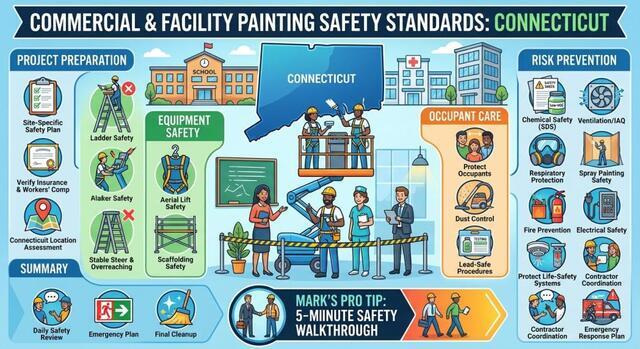
Safety Standards for Commercial & Facility Painting Projects in Connecticut
Commercial Painting Safety Is About Much More Than a Hard Hat
When most people think about commercial painting, they think about colors, coatings, prep work, and price. But there's another factor that should matter just as much when you're choosing a contractor, and that's safety. A commercial painting project can involve ladders, aerial lifts, scaffolding, chemicals, sanding dust, electrical hazards, occupied workspaces, and crews working at serious heights. In healthcare facilities, schools, offices, senior-living communities, warehouses, and other occupied buildings, the contractor also has to think about everyone who keeps using the property while the work is going on.
For commercial properties throughout Connecticut, including New Haven, Branford, Guilford, Madison, North Haven, Hamden, Milford, Fairfield, Bridgeport, Trumbull, Norwalk, Stamford, and Greenwich, safety planning should be a basic part of every painting project. The question shouldn't just be "can this contractor paint our building?" It should also be "can this contractor finish the job without putting people or property at unnecessary risk?"
Start With a Project-Specific Safety Plan
No two commercial painting jobs carry the same hazards. Painting a small professional office is nothing like painting the exterior of a six-story building. A warehouse project might involve forklifts and industrial equipment, a hospital project may call for infection-control precautions, and a school project might come with restricted access and tight scheduling.
Before any work begins, the contractor should be looking at building occupancy, work locations, working heights, ladder and lift needs, surface preparation, dust-producing activities, paints and chemicals, ventilation, electrical hazards, vehicle and pedestrian traffic, emergency access, fire and life-safety systems, equipment protection, weather exposure, and any other contractors on site. The significant hazards should be identified and controlled. On larger or higher-risk projects, that might mean a written site-specific safety plan, a job hazard analysis, and coordination with the facility's own safety representative.
My advice is to ask your contractor to name the three biggest safety risks on your particular project and explain how they plan to control each one. If they can't answer that, they probably haven't looked at the job closely enough.
Verify Insurance and Workers' Compensation
One of the first things to confirm with any commercial painting contractor is that they carry appropriate insurance. Depending on the project and your contract requirements, that might include commercial general liability, workers' compensation, commercial auto, umbrella or excess liability, and any project-specific coverage.
Don't assume a certificate of insurance proves that every person on site is covered. A certificate generally summarizes the policies that exist. It doesn't replace the policies, spell out the exclusions, or guarantee coverage for every worker. That matters most when a contractor uses subcontractors, so ask whether employees or subcontractors will be doing the work, who actually employs the people on site, whether the subcontractors are separately insured, whether workers' comp requirements are being met, whether any owner exclusions or exemptions apply, and whether the coverage meets the property's contractual requirements. In Connecticut, workers' comp obligations depend on the law and the actual working relationship, not on whether someone is labeled a subcontractor or paid with a 1099. Facility managers should ask for current documentation and run any questions past their own insurance adviser.
Ladder Safety
Ladders are probably the most common piece of equipment on a commercial painting job, and they're also a frequent source of falls. Before anyone climbs, the crew should be thinking about whether it's the right ladder for the task, what condition it's in, whether the footing is stable, whether it's set up correctly, whether the reach is appropriate, what's nearby in terms of doors and foot traffic, whether there are electrical hazards, and what the manufacturer's load limits are.
A ladder shouldn't sit where someone can open a door into it without protection. Painters shouldn't stand on steps they're not supposed to stand on, and they shouldn't overreach just to avoid moving the ladder. The right move is to climb down and reposition it, or to bring in better equipment. In an occupied office building in New Haven or a medical facility in Fairfield, ladder placement also has to account for patients, employees, and visitors walking by.
Aerial Lift Safety
Bigger commercial projects often call for aerial equipment like articulating boom lifts, telescopic boom lifts, scissor lifts, and other mobile elevating work platforms. These machines bring their own set of hazards, including falls, tip-overs, overhead obstructions, electrical contact, entrapment, unstable ground, collisions, and equipment malfunction.
Operators need training that fits the equipment and should follow the applicable OSHA requirements and the manufacturer's instructions. Pre-use inspections, a look at ground conditions, the right fall protection, and a rescue plan are all part of operating safely. This is especially important on Connecticut commercial properties, where access might mean sloped pavement, landscaped areas, parking lots, or uneven ground.
Fall Protection
Working at height is one of the most serious hazards in commercial painting. Fall-protection requirements depend on the type of work, the equipment, and the OSHA standard that applies. Construction and general-industry rules aren't identical, and aerial lift requirements differ from certain scaffold requirements, so a professional contractor should know which standards apply to your project.
Depending on the situation, controls might include guardrails, personal fall-arrest systems, proper anchorage, approved work platforms, scaffold protection, controlled access, and worker training. A contractor should never decide fall protection isn't needed just because a task will only take a few minutes.
Scaffolding Safety
Scaffolding may be needed for tall walls, atriums, stairwells, exterior elevations, industrial facilities, and large commercial interiors. It should be properly designed, built, inspected, and used under the applicable safety requirements. That means stable foundations, enough load capacity, safe access, guardrails, fall protection, protection from falling objects, safe platform conditions, attention to weather, and proper electrical clearance. A homemade or improvised arrangement should never be accepted in place of proper equipment.
Protect the Employees, Customers, Patients, and Visitors
A commercial painting contractor's responsibilities go beyond protecting their own crew. The work has to be planned around the people who use the building, whether that's employees, patients, residents, students, customers, tenants, visitors, or delivery drivers. The hazards they face include wet paint, slippery surfaces, trip hazards, falling tools, open work areas, dust, odors, moving equipment, and blocked walkways.
Depending on the project, protection might include temporary barriers, warning signs, controlled work zones, alternate pedestrian routes, floor protection, work during low-traffic periods, or night and weekend scheduling. A busy healthcare facility in New Haven may need far more detailed occupancy planning than an empty office suite in Guilford.
Dust Control During Surface Preparation
Most of the dust in a painting project comes from the prep work, not from putting paint on the wall. Sanding, scraping, grinding, drywall and plaster repair, removing old coatings, cutting materials, and masonry preparation can all kick up dust, and depending on what's being disturbed, that dust can create respiratory and contamination hazards.
Controls can include HEPA-filtered vacuum sanding, local dust extraction, containment barriers, wet methods where they're appropriate, controlled debris removal, suitable respiratory protection, and proper cleaning. Some materials add hazards of their own. Disturbing silica-containing materials can trigger OSHA's silica requirements, and disturbing lead-containing coatings can require specific lead-safe procedures and regulatory compliance. It's never safe to assume painting dust is harmless, so the contractor should know what material is being disturbed before starting any aggressive prep.
Lead Paint and Older Connecticut Buildings
Connecticut has plenty of older commercial, institutional, and mixed-use buildings. Properties in places like New Haven, Bridgeport, Milford, Stamford, and Greenwich may have several generations of coatings and building materials, and older painted surfaces can contain lead. Before anyone disturbs a coating that might contain lead, the contractor and the owner should figure out which regulations apply. That can depend on the building type, the building's age, how it's occupied, the kind of renovation, the work methods, and the federal and Connecticut rules in play.
For example, the federal EPA Renovation, Repair and Painting Rule applies to certain work in pre-1978 housing and child-occupied facilities, so it doesn't automatically cover every commercial building. Other worker-protection and waste-handling requirements may still apply outside that rule. When lead is suspected, testing, evaluation, and qualified professionals may be needed. Sanding or scraping an unknown surface without thinking through the consequences creates risks that are easy to avoid.
Chemical Safety and Safety Data Sheets
Commercial painting uses a long list of materials, including paints, primers, solvents, cleaners, degreasers, epoxies, urethanes, caulks, strippers, adhesion promoters, and specialty coatings. Each one has its own hazards and handling requirements. Contractors should keep the applicable Safety Data Sheets, usually called SDSs, accessible. Those documents cover product hazards, safe handling, storage, protective equipment, first aid, fire precautions, spill response, and exposure controls. Workers should get appropriate hazard-communication training, and facility managers should be told when a product or process introduces unusual risks for building occupants.
Ventilation and Indoor Air Quality
Indoor commercial painting calls for careful attention to air quality. The concerns include paint odors, solvent vapors, dust, aerosols, cleaning products, and coating emissions. Low-VOC coatings may reduce some emissions, but they aren't automatically odor-free or risk-free. How much ventilation is needed depends on the product, the application method, the work area, and who's using the space.
The contractor should be thinking about HVAC operation, fresh-air supply, exhaust, airflow between work zones, containment, how sensitive the occupants are, and drying and curing times. In healthcare facilities, ventilation planning may also need to be coordinated with infection-prevention staff and facility engineering. A painting project shouldn't introduce avoidable air-quality problems into an occupied building.
Respiratory Protection
Some commercial painting activities call for respiratory protection, such as certain spray applications, solvent-based coatings, dust-producing prep, specialty coating systems, and hazardous coating removal. When respirators are required, OSHA's respiratory protection standard may require a written program, medical evaluations, fit testing for tight-fitting respirators, training, and other measures. A basic disposable dust mask isn't the right answer for every painting hazard, so the contractor should choose respiratory protection based on the actual exposure and the requirements that apply.
Spray Painting Safety
Spraying can be efficient on large commercial surfaces, but it brings extra considerations. The potential hazards include overspray, airborne particles, vapor exposure, fire and ignition risks, equipment pressure, injection injuries from high-pressure airless equipment, and contamination of nearby property. Before spraying, the contractor should evaluate ventilation, containment, product hazards, equipment condition, protective equipment, nearby occupants, vehicles, HVAC intakes, and sensitive equipment. A commercial parking lot in Stamford or a warehouse in North Haven may need a very different spray-containment plan than an interior office project.
Fire Prevention
Some coatings, solvents, and related materials can create fire or explosion hazards. Precautions can include proper storage, controlling ignition sources, ventilation, approved equipment, correct waste handling, suitable fire extinguishers, and following the manufacturer's instructions. Oil-soaked or solvent-contaminated rags may need special handling and storage. Contractors should also coordinate with the facility before working near boilers, furnaces, electrical equipment, welding operations, industrial processes, or other ignition sources. Fire prevention belongs in the project plan from the start rather than being treated as an afterthought.
Electrical Safety
Painting crews often work near electrical systems, including overhead power lines, electrical panels, lighting fixtures, outlets, extension cords, temporary power, wet surfaces, and powered equipment. Painters shouldn't operate equipment too close to energized electrical hazards, and electrical panels have to stay accessible as required. Extension cords and temporary power should be appropriate for the equipment and the environment. When electrical systems need to be disconnected or modified, that work belongs to qualified personnel.
Protect Fire and Life-Safety Systems
Commercial buildings depend on critical safety systems, and painting crews have to avoid improperly blocking, damaging, disabling, or covering fire alarms, smoke detectors, sprinklers, exit signs, emergency lighting, fire extinguishers, fire doors, and emergency exits. Some projects do need temporary protection around sensitive devices, and that should be coordinated with authorized facility personnel and the applicable procedures. A painting contractor should never disable a building's life-safety equipment on their own just to make the work easier.
Coordinate With Other Contractors
Large commercial projects often have several trades working at the same time, such as electricians, HVAC technicians, carpenters, flooring installers, roofers, plumbers, cleaning contractors, and general contractors. Poor coordination creates hazards. A painter might be working beneath an electrician, a flooring crew might be applying coatings while painters work overhead, or an aerial lift might be operating near delivery trucks or another contractor's equipment. A coordinated schedule and clearly defined work zones go a long way toward preventing those conflicts.
Weather Safety for Exterior Commercial Painting
Connecticut weather adds its own safety challenges to exterior work. Crews can run into rain, wind, ice, snow, high humidity, summer heat, cold temperatures, lightning, and slippery surfaces. Weather affects both worker safety and how the coating performs. Wind can make lift operation unsafe, ice creates fall hazards, heat raises the risk of heat illness, rain makes surfaces slippery, cold affects coating application, and lightning makes elevated outdoor work dangerous. Contractors should keep an eye on conditions and postpone work when safety or product requirements can't be met. A deadline should never be a reason to operate equipment unsafely.
Healthcare Facilities Require Additional Precautions
Hospitals and medical offices raise their own concerns, including vulnerable patients, infection prevention, dust migration, airflow, sensitive medical equipment, patient privacy, noise, emergency access, and cleaning requirements. Depending on the project, a healthcare facility may require an Infection Control Risk Assessment, or ICRA, before work begins. Controls can include containment, HEPA filtration, dust-control procedures, approved access routes, restricted work hours, environmental-services cleaning, and inspection before the space reopens. The contractor should coordinate with the facility's infection-prevention and engineering teams as appropriate.
Schools and Senior-Living Facilities Require Special Planning
Schools and senior-living communities have their own occupancy concerns. In a school, the contractor should think about student access, classroom schedules, hallway traffic, security, dust, odors, work-zone isolation, and scheduling around vacations and weekends. Senior-living facilities may involve residents with limited mobility, wheelchairs and walkers, respiratory sensitivity, emergency access, staff movement, noise, and room availability. In both settings, the best approach is often to schedule painting when occupants are away from the work area.
Require a Daily Safety Review
On larger or higher-risk projects, the crew leader should run a brief safety review before work starts each day. It should cover what work is planned, what equipment will be used, the major hazards, whether conditions have changed, whether ladders and lifts have been inspected, whether work zones are secure, whether the required protective measures are in place, whether other contractors are nearby, whether the weather is acceptable, and whether everyone understands the emergency plan. Safety planning should carry on through the whole project and not stop after the first day.
Have an Emergency Response Plan
Before a commercial painting project begins, workers should know what to do if something goes wrong. The plan may need to address injuries, falls, medical emergencies, chemical exposure, spills, fire, equipment malfunction, weather emergencies, rescue from elevated equipment, and building evacuation. Crew leaders should know the facility's emergency contacts and procedures. On projects with aerial equipment or fall-arrest systems, rescue planning is especially important.
Questions to Ask a Commercial Painting Contractor About Safety
Before you hire anyone, I'd ask whether they have a written safety program and who's responsible for safety on your project. Will they do a site-specific hazard assessment, and are their employees trained for the equipment they'll use? Do they carry general liability and workers' compensation, will they use subcontractors, and how do they verify subcontractor insurance? What are their procedures for ladder safety and aerial lifts, and what fall-protection systems will they use? How will they control dust, and how do they evaluate lead or other hazardous coatings? What respiratory protection will be required, and how will they handle odors and ventilation? How will they protect occupants, keep emergency exits accessible, and protect fire alarms and sprinklers? How will they coordinate with other contractors, what's their emergency response procedure, and how are safety concerns reported and corrected? Can they provide references from similar commercial facilities? A professional contractor should be comfortable talking through all of it.
Red Flags When Hiring a Commercial Painting Contractor
Be cautious if a contractor can't explain their safety procedures, uses visibly damaged ladders, or has no training process for aerial lifts. The same goes for anyone who can't explain fall protection, fails to secure occupied work areas, or leaves cords and equipment in walkways. Other warning signs include not asking about hazardous coatings, using spray equipment without the right precautions, being unable to provide insurance documentation, having no on-site supervision, ignoring ventilation, blocking emergency exits, disabling life-safety equipment without authorization, or not being able to explain how accidents and emergencies would be handled. A low price doesn't make up for unsafe work practices.
Mark's Pro Tip: Ask for a Five-Minute Safety Walkthrough
Before you approve a major commercial painting project, ask the contractor to walk the property with you and say, "Show me where the risks are and how you're going to protect the people using this building." A knowledgeable contractor should be able to point out things like a busy pedestrian entrance, a narrow hallway, an elevated work area, an electrical hazard, a sensitive patient area, a location that needs a lift, a surface that needs a hazardous-material evaluation, or an area that should be painted after hours. That conversation can tell you a great deal about how they approach the work.
Commercial Painting Safety Checklist
Before the project starts, I'd confirm that site-specific hazards have been reviewed, insurance documentation has been checked, workers' comp has been verified as appropriate, and any subcontractor arrangements have been reviewed. A project supervisor should be named, and ladder safety, aerial lift safety, fall protection, and scaffold requirements should all have been covered. Dust-control procedures should be set, hazardous coatings evaluated, SDS information available, a ventilation plan in place, respiratory protection evaluated, and spray containment planned. Fire precautions and electrical hazards should be addressed, occupant access protected, emergency exits maintained, and life-safety systems protected. Other contractors should be coordinated, weather conditions evaluated, emergency procedures established, daily safety reviews scheduled, and final cleanup and inspection planned.
Bottom Line
Safety should never be an afterthought in commercial painting. A professional contractor should know how to protect their employees, building occupants, patients, students, tenants, visitors, other contractors, equipment, property, and emergency access. That takes more than basic protective gear. It takes training, planning, supervision, communication, and a willingness to stop or adjust the work when conditions turn unsafe.
At MDF Painting & Power Washing, we believe commercial painting should be approached with the same professionalism as any other building-maintenance or construction project. We serve commercial and institutional properties throughout Connecticut, particularly New Haven and Fairfield counties. The goal isn't just to finish the painting. It's to finish it properly while protecting the people and property involved.
Frequently Asked Questions
Does OSHA apply to commercial painting contractors in Connecticut?
Yes. Commercial painting employers are subject to the applicable federal OSHA standards. Which requirements apply depends on the activity, the work environment, the equipment, and the circumstances.
Do commercial painters need fall protection?
It can be required, depending on the height, the activity, the equipment, and the OSHA standard that applies. Requirements differ for construction, general industry, scaffolds, and aerial lifts.
Are aerial lift operators required to be trained?
Yes. Employers must make sure operators get appropriate training and instruction for the equipment and the work requirements.
Should commercial painting contractors carry workers' compensation insurance?
Connecticut employers generally must carry workers' comp when state law requires it. Property owners should verify the contractor's coverage and any relevant subcontractor arrangements.
Can commercial painting happen while a building is occupied?
Often, yes. Barriers, access controls, dust containment, ventilation, scheduling, and safety procedures can allow painting to be done in phases while the facility keeps operating.
Is low-VOC paint automatically safe for occupied buildings?
No. VOC content alone doesn't decide whether a product suits an occupied space. Ventilation, product ingredients, application method, odor, drying, and curing all have to be considered too.
Do older Connecticut commercial buildings require lead-paint testing?
Not every commercial project automatically requires lead testing, but older coatings should be evaluated for potential hazards before anyone disturbs them. The requirements depend on the building, the work, and the exposure.
Who is responsible for safety on a commercial painting project?
It depends on the law, the contractual relationships, and who controls the work. Contractors have obligations to their workers, and property owners, general contractors, and facility managers may have relevant responsibilities too.