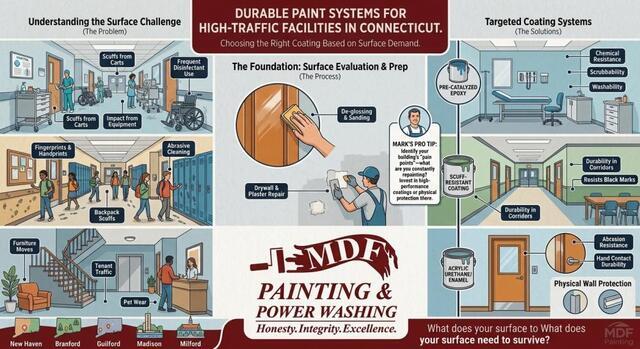
Durable Paint Systems for High-Traffic Facilities in Connecticut
In a High-Traffic Building, Ordinary Paint May Not Be Enough
Not every painted wall lives the same life. A private executive office might go years without a scratch. A hospital corridor gets hit by carts, wheelchairs, equipment, cleaning chemicals, and hundreds of people every single day. A school hallway deals with backpacks, fingerprints, shoes, chairs, sports equipment, and constant cleaning. An apartment-building stairwell is under nonstop pressure from tenants, pets, furniture, deliveries, and move-ins.
That's exactly why picking paint for a commercial facility should involve a lot more than just choosing a color. The real question I always start with is: what does this surface actually have to survive? For high-traffic commercial properties across Connecticut — healthcare facilities in New Haven, office buildings in Branford, apartment communities in Milford, schools in Fairfield, larger facilities in Stamford — the right coating system can improve appearance, make day-to-day maintenance easier, and often stretch out the time between major repaints.
What Actually Counts as a High-Traffic Facility?
A high-traffic facility is any building, or any part of a building, that sees serious daily contact, movement, cleaning, or impact. That covers hospitals, medical offices, schools, universities, senior-living and assisted-living communities, apartment buildings, condo communities, hotels, retail stores, restaurants, office buildings, municipal buildings, fitness centers, warehouses, and manufacturing facilities. Even within those buildings, certain spots take far more abuse than the rest — entrances, lobbies, corridors, stairwells, elevators, restrooms, waiting rooms, break rooms, cafeterias, doors, door frames, handrails, corners, and loading areas. The coating system really needs to match whatever that specific environment dishes out.
Start With the Surface, Not the Paint Can
One of the biggest mistakes I see in commercial painting is picking the finish coat before anyone's actually evaluated the surface underneath it. Before recommending anything, I want to know what the substrate actually is, what's currently on it, whether that existing coating is sound, whether the surface is glossy, whether there's moisture or rust involved, whether the coating's already peeling or showing adhesion problems, whether the wall itself is damaged, how it gets cleaned, what chemicals touch it, how often it's touched, and how much impact it takes. All of that determines the prep, the primer, and the finish system that follows. A premium finish coat over a poorly prepped surface is still, at the end of the day, a poor paint job.
1. Preparation Is the Real Foundation of Durability
When a coating fails early, the paint itself usually isn't the problem — the preparation is. Good prep can mean cleaning, degreasing, removing loose paint, sanding, de-glossing shiny surfaces, repairing drywall or plaster, treating rust, removing failed caulk, filling holes, spot priming, and applying a bonding or stain-blocking primer where needed. How much prep a job needs should track with the existing condition of the surface and the new coating system going on top of it. High-performance coatings don't eliminate the need for proper prep — if anything, the more demanding the environment, the more that prep work actually matters.
2. High-Performance Acrylic Coatings
Modern high-performance waterborne acrylics are a genuinely strong option for a lot of commercial interiors — offices, exam rooms, waiting rooms, classrooms, conference rooms, common areas, and lower- to moderate-traffic corridors. Depending on the specific product, you can get low odor, fast drying, good washability, easy application, easier touch-up down the road, solid color retention, and lower-VOC options. These make a lot of sense when a facility needs more durability than standard residential paint but doesn't need to jump straight to a complex industrial system. That said, not every acrylic performs the same — it's worth actually reviewing a specific product's technical data rather than assuming all "commercial paint" offers similar durability, because it doesn't.
3. Scuff-Resistant Coatings
For a lot of high-traffic commercial interiors, scuffing is the biggest everyday appearance problem. Think about the lower walls in hospital corridors, school hallways, apartment common areas, hotel corridors, waiting rooms, and senior-living communities — these surfaces are in constant contact with shoes, bags, carts, wheelchairs, furniture, equipment, and cleaning tools. Scuff-resistant architectural coatings are built specifically for environments where maintaining appearance actually matters, and they're genuinely useful across busy Connecticut communities like New Haven, Fairfield, Bridgeport, Norwalk, and Stamford, where repainting long corridors over and over gets expensive and disruptive fast.
4. Pre-Catalyzed Water-Based Epoxy
For areas that need more durability and cleanability than a standard acrylic can offer, a pre-catalyzed water-based epoxy is worth a look — medical offices, exam rooms, treatment areas, corridors, labs, restrooms, institutional spaces, and utility areas all fit the bill. Depending on the specific product, you're generally looking at improved scrub resistance, stain resistance, chemical resistance, washability, and durability. These coatings land nicely between conventional architectural paint and the more demanding two-component systems — though it's still worth confirming compatibility with whatever cleaning chemicals the building actually uses.
5. Two-Component Epoxy Coatings
Some environments genuinely need a tougher system than anything else on this list — industrial areas, labs, utility rooms, service corridors, mechanical spaces, high-abuse walls, manufacturing environments, and certain floors. Two-component epoxies bring excellent adhesion, hardness, chemical resistance, abrasion resistance, and moisture resistance, but they're also more complicated to work with — mixing ratios, limited pot life, specific application conditions, more demanding prep, stronger odor, ventilation needs, recoat windows, cure time, and return-to-service time all come into play. A stronger coating isn't automatically the better coating. The right coating is whatever actually fits the real environment it's going into.
6. Urethane and Polyurethane Coatings
Urethane-based systems get used where a surface needs extra abrasion, chemical, or wear resistance — doors, frames, railings, trim, equipment areas, floors, and industrial surfaces. Some systems even work as a protective topcoat layered over another coating entirely. As always, product selection comes down to the specific substrate and exposure — the word "urethane" by itself doesn't tell you whether a given coating is actually right for your project.
7. Doors and Frames Deserve Special Attention
In most commercial facilities, doors and frames show wear long before the walls do — they're constantly touched, scratched, hit, cleaned, kicked, scraped by carts, and banged up during deliveries. Commercial doors and frames often do better with higher-performance products like acrylic urethane, institutional enamel, waterborne enamel, epoxy, or other specialty coatings. The right system depends on what's underneath — wood, previously painted metal, factory-finished metal, fiberglass, or something else — and surface prep becomes especially critical on glossy or factory-finished surfaces that don't want to hold a new coating to begin with.
8. High-Touch Surfaces Need More Than Just Good Paint
Certain parts of a building take constant hand contact — doors, door frames, railings, reception counters, window ledges, trim, and handrails. These surfaces benefit from coatings with better washability, hardness, block resistance, chemical resistance, and abrasion resistance. But sometimes paint on its own just isn't enough. In the most heavily abused areas, it's worth considering corner guards, wall protection, chair rails, impact-resistant panels, or protective coverings. If a cart hits the same corner a hundred times a week, repainting that corner again and again isn't really solving anything. Sometimes the right answer is physical protection, not another coat of paint.
9. Corners Are Usually the First Thing to Fail
Walk through almost any heavily used commercial building and look at the outside corners — chips, dents, scrapes, exposed corner bead, and repeated drywall patches are a near-universal story. Paint alone often can't fix this. The better answer might be corner guards, stronger drywall repair, a higher-performance coating, physical wall protection, or more frequent maintenance. A good contractor should be identifying why that same corner keeps failing, instead of just repainting it every few months and calling it done.
10. Healthcare Facilities Need Cleanability and Durability Together
Healthcare environments put unique demands on paint — frequent cleaning, disinfectants, wheelchairs, medical carts, equipment, constant hand contact, stains, occasional bodily-fluid exposure, and repeated maintenance all factor in. Patient corridors, waiting rooms, nurse stations, exam rooms, treatment rooms, and rehab spaces may all need different coating systems from each other. A medical facility in New Haven can end up needing a very different wall coating than a small professional office in Guilford. I always want to know exactly what cleaning products a facility uses and confirm the coating can actually tolerate them before specifying anything.
11. Schools Are Some of the Toughest Environments Around
Schools might be one of the hardest environments architectural paint ever has to survive. Think about what a middle-school hallway goes through in a single week — backpacks, shoes, hands, sports equipment, chairs, desks, food, drinks, cleaning, and hundreds of students moving through at once. Corridors, cafeterias, stairwells, classrooms, restrooms, gym entrances, and common spaces generally benefit from durable, washable, scuff-resistant coatings. That said, different spaces justify different levels of performance — an administrative office doesn't need the same coating as the main student corridor taking all that daily abuse.
12. Senior-Living Facilities Need Durability That Doesn't Feel Institutional
Senior-living and assisted-living communities present an interesting balancing act. They genuinely need durable surfaces, but residents generally don't want their home looking like an industrial facility. The coating system needs to balance appearance, warmth, color, washability, scuff resistance, low odor, maintenance, and durability all at once. Corridors, dining areas, activity rooms, elevator lobbies, entrances, nurse stations, and resident common areas tend to be the high-wear spots. Color and sheen become especially important here, because the space still needs to feel like home, not a hospital.
13. Apartment and Condominium Common Areas Wear Differently
Apartment and condo buildings experience their own particular style of wear — furniture moves, deliveries, pets, bicycles, strollers, luggage, packages, and the daily churn of resident traffic all take a toll on common-area walls. Stairwells and hallways often need more durable coatings than the individual units themselves. Properties throughout New Haven, Milford, Fairfield, Norwalk, and Stamford can meaningfully cut down on repaint frequency by investing in better systems for their high-use common areas.
14. Retail Properties Need to Stay Presentable
In retail, appearance directly affects the customer experience. Walls take damage from shopping carts, displays, stocking, deliveries, customers, cleaning, and constant merchandise changes. A heavily scuffed entrance or checkout area can make an otherwise successful store look neglected without anyone intending it. Retail maintenance plans often combine durable coatings with regular touch-ups, after-hours painting, and scheduled inspections — the goal is keeping the store looking consistently sharp without constantly disrupting customers to do it.
15. Industrial and Warehouse Facilities Need Their Own Systems
An industrial facility shouldn't automatically get the same products as an office building. Industrial surfaces deal with forklifts, pallets, chemicals, oils, moisture, abrasion, heat, equipment, and heavy cleaning — a completely different list of demands. That usually points toward epoxy, urethane, corrosion-resistant coatings, industrial enamels, resinous floor systems, or specialty primers, selected based on the specific chemical, physical, and environmental exposure that space actually faces.
16. Sheen Matters, But It's Not the Whole Story
Traditionally, higher-sheen paints got chosen for durability and washability, but modern coating technology has changed that calculus somewhat — some lower-sheen products today offer excellent durability in their own right. Flat or matte hides surface imperfections well, though it's not always the first choice for serious abuse unless you're using a high-performance formulation. Eggshell is common in offices, waiting areas, and general commercial interiors where appearance and moderate washability both matter. Satin often shows up in higher-traffic areas where extra cleanability is useful. Semi-gloss gets considered for doors, frames, trim, restrooms, and utility areas, though it highlights surface imperfections more than lower sheens do. My approach is always to pick the coating technology first, then choose the right sheen within that system — not the other way around.
17. The Wrong Cleaning Chemicals Can Ruin the Wrong Paint
One of the most overlooked questions in commercial painting is simply: what do you actually clean these walls with? Facilities use everything from general-purpose cleaners and degreasers to disinfectants, alcohol-based products, bleach, and hydrogen-peroxide products. A coating can hold up fine against soap and water and still deteriorate under repeated exposure to something stronger — showing up as softening, discoloration, loss of sheen, staining, premature wear, or outright coating failure. Before specifying a system for a healthcare, lab, food-service, or industrial environment, I always want to review the facility's actual cleaning procedures, and where it makes sense, get written compatibility confirmation directly from the coating manufacturer.
18. Give the Coating Time to Actually Cure
One of the easiest ways to ruin a brand-new commercial paint job is putting it into full service too quickly. Paint can be dry to the touch without being fully cured, and during that curing window, the coating is genuinely more vulnerable to scrubbing, impact, chemicals, blocking, abrasion, and moisture. This matters a lot during night and weekend projects — just because employees walk back in Monday morning doesn't mean every freshly painted surface is ready to be scrubbed down or put through heavy use. It's worth following the manufacturer's actual recommendations here rather than assuming dry means ready.
19. Color Choice Affects Durability Too
Color isn't purely an aesthetic call. Very light colors tend to show dirt, handprints, and scuffs more readily. Very dark colors can show dust, scratches, surface imperfections, and touch-up differences just as easily, in their own way. In a lot of high-traffic facilities, medium-tone colors do a nice job of hiding everyday wear, and darker accent colors can be used strategically on lower walls, doors, frames, and other high-contact areas. The goal isn't to hide poor maintenance — it's choosing a color scheme that actually fits how the building gets used day to day.
20. Build a Real Coating Schedule for the Whole Facility
Larger commercial properties really benefit from a formal coating schedule — documenting the location, substrate, existing coating, prep, primer, finish product, color, sheen, number of coats, date completed, cleaning requirements, cure time, and maintenance needs for each area. As a rough guide, executive offices usually just need a high-quality acrylic for appearance and moderate washability. Main corridors want a high-performance scuff-resistant coating. Exam rooms do well with a high-performance acrylic or a compatible epoxy system for cleanability and disinfectant exposure. Doors and frames need a durable enamel or acrylic-urethane for abrasion and hand contact. Restrooms need a moisture-resistant high-performance coating. Utility rooms often call for epoxy or a specialty coating for chemical and moisture resistance. Warehouse walls need a true industrial coating system for impact and exposure. And high-abuse corners usually do best with a coating paired with actual physical wall protection. The exact system should always come back to the real substrate, exposure, cleaning procedures, and manufacturer recommendations for that specific space.
Don't Automatically Reach for the Most Expensive Paint Everywhere
More expensive doesn't automatically mean better, and the most durable coating on the shelf doesn't need to go on every wall in the building. I find it helpful to think of a facility in zones. Low-traffic areas — private offices, storage rooms, limited-access spaces — do fine with a quality architectural coating. Moderate-traffic spaces — conference rooms, waiting areas, general offices — benefit from a more washable commercial-grade coating. High-traffic areas — corridors, lobbies, stairwells, classrooms, common areas — are where a high-performance or scuff-resistant coating earns its keep. And severe-service areas — labs, industrial spaces, utility rooms, heavily cleaned spaces — are where specialty epoxy, urethane, or industrial systems actually make sense. Spend the coating budget where the building genuinely needs that performance, not everywhere equally.
Questions Worth Asking Before Choosing a High-Traffic Coating
I'd want to know the substrate, what's currently on it, and whether that existing coating is sound. How much traffic does the area actually see, and what usually damages the surface in the first place? How often does it get cleaned, with what chemicals, and is moisture a factor? Does the space need chemical resistance, impact resistance, or scuff resistance specifically? Will it need frequent touch-ups, and how quickly does it have to return to service after painting? Is odor a concern, and are low-VOC products preferred? What sheen actually makes sense here, and would physical wall protection help alongside the coating? What prep does the surface need, and is a primer required? And finally, what's the expected ongoing maintenance plan? These questions get you a lot further than simply asking "what's your best paint?"
Red Flags Worth Watching For
I'd be cautious of anyone recommending one single product for an entire facility regardless of use, who doesn't actually inspect the existing surface, or who never asks how the area gets cleaned. Watch for someone ignoring moisture, painting directly over rust, skipping a necessary primer, or assuming expensive paint means less prep work is needed. I'd also flag a contractor who can't provide real product data, doesn't discuss cure time, chooses coatings purely based on color, recommends residential products for serious commercial exposure without a good reason, promises a coating is "indestructible," or can't explain the difference between scuff resistance and impact resistance. No paint is indestructible — the real objective is finding the best-performing practical system for the environment it's actually going into.
Mark's Pro Tip: Find Your Building's "Pain Points"
Before picking any paint, I'd walk the building and ask the maintenance staff one simple question: "What are we constantly repainting?" Maybe it's the first four feet of the main corridor, the elevator lobbies, the stairwell walls, the door frames, the corners outside the cafeteria, the hallway leading to the loading dock, the patient corridor, or the entrance to the gym. Those are your building's pain points. Instead of upgrading every gallon of paint used across the entire property, invest first in improving the coating system — or adding physical protection — in those specific spots. That's where a better system actually pays for itself.
Bottom Line
The best paint for a high-traffic commercial facility isn't necessarily the most expensive paint on the shelf. It's the coating system that actually matches the substrate, the traffic, the cleaning procedures, the moisture, the chemicals, the level of impact, the appearance the building needs, and how it's actually maintained day to day. A private office and a hospital corridor shouldn't automatically get the same paint. Neither should a classroom and a mechanical room.
For commercial facilities throughout Connecticut — including properties in New Haven, Branford, Guilford, Madison, North Haven, Hamden, Cheshire, Milford, Fairfield, Bridgeport, Trumbull, Westport, Norwalk, Stamford, and Greenwich — the goal should always be identifying where the building actually takes the most abuse and specifying coatings accordingly.
At MDF Painting & Power Washing, we believe commercial coating selection should start with understanding how the building is actually used. Because the real question isn't simply "what paint should we use?" It's "what does this surface need to survive?"
Frequently Asked Questions
What is the best paint for high-traffic commercial walls?
There's no single best product for every building. High-performance acrylics, scuff-resistant architectural coatings, pre-catalyzed epoxies, and other specialty systems can all be the right fit, depending on traffic, cleaning, substrate, and exposure.
Is epoxy better than regular commercial paint?
Epoxy offers greater durability and chemical resistance in the right environment, but it's often overkill in ordinary offices and public spaces. The coating should match the actual service environment, not just be the "strongest" option available.
What's the best paint for hospital corridors?
Hospitals generally benefit from coatings with excellent washability, scuff resistance, stain resistance, and compatibility with the facility's own cleaning products. The specific system should be coordinated directly with facility requirements.
What paint is best for school hallways?
A durable, washable, scuff-resistant coating usually makes the most sense. Areas that take repeated physical impact can also benefit from corner guards or additional wall-protection systems.
What's the best paint sheen for commercial hallways?
Eggshell, satin, and other durable finishes are commonly used, but the formulation matters more than sheen alone — a high-performance lower-sheen coating can genuinely outperform a conventional higher-sheen product.
Why does paint keep coming off commercial door frames?
It usually comes down to poor preparation, an incompatible coating, a glossy surface, contamination, the wrong primer, repeated impact, or simply the wrong finish product for that surface. The actual cause should be identified before repainting, or the problem just comes back.
Can you use residential paint in a commercial building?
Sometimes, depending on the area and what's actually required of it. But heavily used commercial spaces generally do better with coatings built for greater washability, abrasion resistance, chemical resistance, or scuff resistance.
Does more expensive paint always last longer?
No. Surface preparation, substrate condition, coating compatibility, application quality, traffic, cleaning routine, and environmental exposure all shape how long a coating actually lasts — price alone doesn't determine that.
Should every room in a commercial facility use the same paint?
Usually not. Different areas have genuinely different performance needs, and building a real coating schedule lets a facility match the right product to each environment instead of defaulting to one product everywhere.