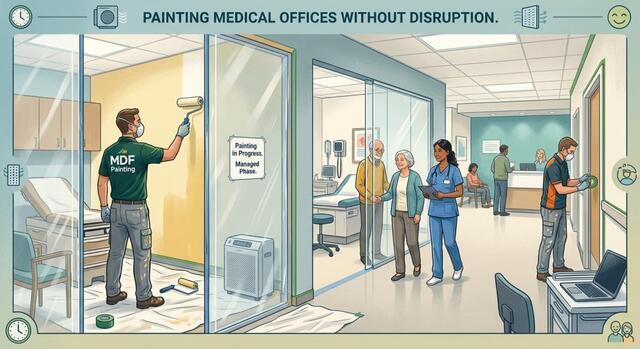
Painting Medical Offices Without Disrupting Daily Operations in Connecticut
Medical Office Painting Requires Careful Planning
A medical office usually can't just close its doors for a few days while a painting crew works through it. Patients still need their appointments. Staff still need access to their workspaces. Exam rooms, hallways, reception areas, labs, and administrative offices often all need to stay functional the entire time a project is underway.
That's especially true for busy Connecticut practices serving communities across New Haven and Fairfield counties — New Haven, Branford, Guilford, Madison, North Haven, Hamden, Cheshire, Milford, Orange, Wallingford, Fairfield, Westport, Norwalk, Stamford, Greenwich, Trumbull, Shelton, Stratford, and Bridgeport. Painting a medical office really has to be planned around how that practice actually operates day to day — patient schedules, staff workflow, privacy, odor control, dust containment, cleaning, noise, access routes, medical equipment, safety, product selection, and how long everything needs to dry and cure. A successful project should leave the facility looking better and holding up longer, without adding unnecessary stress for patients or interrupting the care the practice provides.
Why This Kind of Painting Is Genuinely Different
Painting a medical office isn't like painting a regular commercial space. A Connecticut practice might be serving elderly patients, kids, people with respiratory conditions, patients with chemical sensitivities, immunocompromised individuals, people getting urgent treatment, or patients already dealing with pain, anxiety, or nausea. Even a small disruption can land differently on someone in that position. Strong odors, a blocked hallway, loud prep work, furniture moved out of place, or visible construction dust can all make patients uncomfortable and slow staff down in the process. Whether it's a small physician's office in Guilford, a pediatric practice in Branford, a specialty office in Fairfield, or a large outpatient facility in Stamford, the contractor needs to remember first and foremost that this is a healthcare environment, not a blank canvas.
1. Start With a Real Operational Planning Meeting
Before pricing anything or building a schedule, I want to sit down with the people who actually understand how the practice runs — the practice manager, facility manager, office administrator, clinical supervisor, infection-prevention rep, environmental-services staff, building management, security, and sometimes IT. That conversation should cover appointment hours, the busiest days, quieter periods, any sensitive treatment areas, how patients actually move through the space, staff-only zones, emergency exits, who's responsible for cleaning, which hours are approved for work, and any product restrictions the practice has.
A dermatology office in Madison operates very differently than an urgent-care facility in Milford or a multi-specialty practice in Norwalk. The schedule should be built around the medical practice's needs — not around whatever's most convenient for the painting crew.
2. Break the Project Into Manageable Phases
Trying to paint an entire occupied medical office all at once usually just creates confusion and more disruption than necessary. A phased approach almost always works better — splitting the project up by department, hallway, floor, a group of exam rooms, an administrative area, reception, or by whichever zone makes sense for evening or weekend work.
In practice, that might look like painting two exam rooms each evening, tackling reception over a weekend, handling administrative offices after hours, breaking hallways into small sections, or hitting the break room during a scheduled closure. This approach really pays off in larger medical buildings in New Haven, Bridgeport, Stamford, Greenwich, or Fairfield, where multiple departments often share hallways, elevators, entrances, or waiting rooms. Each finished section should be cleaned and put back into service before moving on to the next one.
3. Work Around Low-Impact Hours
Medical office painting tends to go smoothest at night, on weekends, during scheduled closures, between patient sessions, over holiday shutdowns, during staff training days, before a new office opens, or right after a department relocates. A busy practice in Hamden or North Haven might prefer evening work, while a Fairfield County office with long weekday hours might need the project spread across several weekends instead.
It's also worth understanding exactly how long each product needs to dry, recoat, cure, stop producing noticeable odor, become washable, and become genuinely safe for normal use. The goal is never to reopen a freshly painted area before it's actually ready — a wall can feel dry to the touch while the coating underneath is still curing and vulnerable to damage.
4. Keep Patient and Staff Access Open
Painting equipment should never get in the way of patient care. The plan needs to protect clear access to entrances, exits, exam rooms, restrooms, reception desks, elevators, stairwells, emergency equipment, fire extinguishers, electrical panels, medical-gas equipment, and medication storage — and walkways need to stay clear and safe at all times. This matters even more in buildings serving older adults, patients in wheelchairs, parents with kids, or anyone with limited mobility.
If a corridor genuinely has to close temporarily, the contractor and the practice should agree ahead of time on alternate routes, signage, barriers, staff notifications, accessibility accommodations, and emergency procedures. No patient should ever have to step over a drop cloth, a hose, a cord, or a ladder to get where they're going.
5. Get Serious About Odor Control
Odor is probably the number one concern I hear about when painting an occupied medical office. Even low-VOC coatings can still have a noticeable smell, so it's worth thinking through product selection, ventilation, timing, room isolation, air movement, drying time, and how sensitive nearby patients might be — especially if you're near pediatric, respiratory, oncology, behavioral-health, or senior-care areas.
Strong-smelling solvents, primers, cleaners, or caulks shouldn't get introduced without the practice's sign-off. Where possible, I'd lean toward low-odor coatings, low- or zero-VOC products, water-based primers, approved patching materials, low-emission caulks, and controlled ventilation throughout. That said, the lowest-odor product isn't always the most durable or the right fit — the facility needs to weigh occupant comfort against actual performance requirements.
6. Keep Dust Under Control During Prep
Most of the dust in a painting project actually comes from preparation, not from the paint itself — sanding repairs, scraping old coatings, cutting into drywall, drilling, removing wall coverings, repairing plaster, pulling out damaged caulk, and prepping doors and trim all kick up dust. HEPA-filtered vacuum sanding, localized barriers, floor-to-ceiling containment when it's warranted, plastic sheeting, dust extraction, damp cleaning, covered waste containers, and controlled removal routes all help keep it contained.
Open sanding near occupied patient areas just isn't a good idea. The level of containment should scale with how much dust the work generates and how sensitive the nearby patients are — and that holds true whether it's a historic medical building in New Haven, a modern outpatient center in Trumbull, or a small private practice in Cheshire.
7. Protect the Medical Equipment and Technology
Medical offices are full of equipment that's expensive, sensitive, or both — exam tables, diagnostic equipment, computers, monitors, printers, phones, medical refrigerators, lab equipment, wall-mounted devices, nurse-call systems, security systems, and network equipment. None of it should be unplugged, moved, covered, or disconnected without the go-ahead. Some of it needs continuous power, climate control, data connectivity, or calibration that a crew shouldn't be disturbing on their own — so protecting it properly means coordinating with clinical, facilities, and IT staff before work starts, not figuring it out on the fly.
8. Protect Patient Privacy
Painting crews often end up working right next to confidential information. Workers should never be accessing, photographing, or discussing patient charts, computer screens, appointment schedules, prescription information, billing records, lab results, or anything overheard from a patient conversation. Before work starts, the practice should secure paper files, computer stations, whiteboards, printed schedules, labels, medication records, and anything else that identifies a patient. The contractor should train the crew to stay in their approved areas and steer clear of sensitive materials entirely — this matters just as much for a one-provider office in Orange as it does for a large regional practice in Stamford.
9. Bring in a Professional, Identifiable Crew
A medical office should always know exactly who's walking through their doors. Workers should be identifiable, properly insured, trained, supervised, familiar with the specific rules of that project, and professional in how they look and act. I'd steer well clear of sending unfamiliar or unapproved workers to a healthcare facility.
Every crew member should know the approved entrances, work hours, restricted areas, break locations, restroom access, noise limits, privacy expectations, emergency procedures, and cleanup responsibilities — and there should be a designated crew leader on-site whenever work is happening. For Connecticut healthcare facilities, that level of accountability isn't optional, especially when crews are working inside occupied offices after hours.
10. Keep the Noise Down
Painting itself can be pretty quiet, but the prep work often isn't — sanders, vacuums, ladders, scraping, drilling, moving furniture, pulling doors, setting up equipment, and crew members talking back and forth can all add up. It's worth identifying which tasks are the noisy ones and scheduling those outside patient hours whenever possible, saving the quieter tasks — careful rolling, touch-up work — for limited occupied periods when the practice has approved it. And the facility should always get a heads-up before any task that's likely to make significant noise.
11. Choose Coatings That Are Actually Built to Last
Medical offices need more than an attractive color on the wall — those surfaces face frequent cleaning, disinfectants, constant hand contact, wheelchairs, carts, equipment, moisture, stains, and repeated scrubbing. The right coating depends on the area. Reception and waiting areas do well with something washable, scuff-resistant, attractive, and easy to maintain. Exam rooms need coatings that are cleanable, durable, low-odor, and able to stand up to routine disinfectants. High-traffic corridors often call for higher-performance coatings with scuff resistance, impact protection, and easy touch-up. Restrooms and utility areas need real moisture and mildew resistance along with improved washability. Before recommending any of this, I want to know what cleaning products the facility actually uses — which matters a lot for busy practices in Bridgeport, Norwalk, New Haven, and Stamford, where waiting rooms and corridors see heavy daily traffic.
12. Think Through Color Changes Carefully
Color genuinely shapes the atmosphere of a medical office. A lot of Connecticut practices lean toward colors that feel calm, clean, professional, welcoming, bright, and reassuring — but the right choice also depends on the existing flooring, furniture, branding, lighting, wayfinding, how departments are identified, the patient population, and accessibility. A pediatric office in Fairfield is probably going to land on a very different palette than an orthopedic practice in Shelton or a behavioral-health office in New Haven.
Before committing to a color across the whole facility, it's worth applying sample areas first — colors can look surprisingly different under fluorescent lighting, LED lighting, natural daylight, evening light, or in a windowless room. The practice should sign off on both color and sheen before any materials get ordered.
13. Set Up a Real Daily Communication Process
Occupied medical office projects need frequent, clear communication. I'd expect regular updates on which areas are finished, which are opening back up, which are still closed, what's planned for the next shift, any odor concerns, unexpected repairs that came up, schedule changes, drying time, and access restrictions. One person from the facility and one from the contractor should be the designated points of contact — it keeps instructions from getting crossed and confusion from creeping in, especially on larger multi-office projects across New Haven and Fairfield counties.
14. Actually Clean Before Reopening Each Area
An area shouldn't go back into service just because the paint feels dry. Before reopening, the crew should remove waste, pull off tape and coverings, HEPA vacuum where needed, damp wipe surfaces, clean the floors, reinstall outlet and switch covers, put approved furniture back, confirm fixtures still work, remove signs and barriers, check for lingering odor, finish any touch-ups, and do a final walkthrough. Some practices will also want their own environmental-services team to do a cleaning pass before patients return.
15. Be Ready for the Unexpected
Medical office painting sometimes uncovers water damage, mold, failed drywall, loose wall coverings, damaged plaster, rust, old coating failures, hidden staining, cracked caulk, or deteriorated trim. Older medical buildings in cities like New Haven, Bridgeport, and Stamford tend to need more repair planning, while even newer offices can have surprises from old leaks, equipment impact, or years of repeated cleaning.
None of that should just get painted over. Unexpected conditions need to be documented, reported, evaluated, priced, approved, and corrected before painting continues — and the practice should know in advance exactly how change orders will be handled if something like this comes up.
16. Keep Life-Safety Systems Fully Functional
Painting crews need to steer clear of blocking or damaging exit signs, fire alarms, smoke detectors, sprinklers, emergency lights, fire extinguishers, electrical panels, medical-gas outlets, or security devices. Covering or temporarily disabling any life-safety equipment usually requires formal approval and its own protection procedures — a painter should never independently cover a detector, sprinkler, alarm, or emergency device without getting the green light first.
17. Put It All in a Written Plan
The written plan should spell out the areas included and excluded, the work phases, hours, products, colors, prep procedures, dust and odor controls, protection procedures, equipment responsibilities, access routes, cleanup requirements, communication contacts, emergency procedures, and the final inspection process. A written plan cuts down on misunderstandings and lets the practice prepare its own staff before each phase kicks off.
Questions Worth Asking a Medical Office Painting Contractor
I'd ask whether they've painted occupied medical offices in Connecticut before, and specifically in New Haven or Fairfield County. Can they work nights or weekends? How will they phase the project, control dust, and what HEPA-filtered equipment do they actually own? How will they manage odor, and which products do they recommend — can those products handle the practice's disinfectants? How will they protect medical equipment and patient information? Who's supervising the project, and will the same crew stay on-site the whole time? How are workers screened and identified? How will patient and staff access stay open, and how will schedule changes get communicated? What happens if hidden damage turns up? How will each area get cleaned before reopening, and how will they handle life-safety devices? What warranty do they offer, and can they provide references from similar Connecticut facilities? A contractor worth hiring should answer all of this with a real process, not vague reassurances.
Red Flags Worth Watching For
I'd be cautious of a contractor with no real experience in occupied healthcare spaces, who can't offer a phasing plan, or who plans to sand openly near patients. Same goes for anyone with no odor-control strategy, who suggests going with the cheapest paint available, or who can't explain how they'll protect equipment. Watch for unfamiliar or unapproved labor, no on-site supervisor, no real discussion of patient privacy, an inability to work outside normal business hours, no plan for daily cleanup, disregard for life-safety systems, a vague proposal, or a failure to coordinate with practice management. A medical office project should never be handled like an ordinary vacant-space repaint — the stakes are just different.
Mark's Pro Tip
Before the project starts, I like to build a room-by-room reopening checklist. For each area, confirm the painting and touch-ups are complete, the surfaces are actually dry, the odor is acceptable, equipment is functional, floors are clean, furniture is back in place, privacy materials are secured, life-safety devices are unobstructed, and staff has actually approved the space. That last step matters — it keeps a room from getting reopened to patients before it's genuinely ready.
Common Mistakes I See in Medical Office Projects
The most common one is trying to paint too many areas at once. Close behind that is scheduling noisy work during patient hours, underestimating how noticeable odor really is, and failing to protect air returns properly. I'd also flag open sanding methods, blocked hallways, moving medical equipment without authorization, cords left across walkways, disregard for patient privacy, unknown workers on-site, rooms reopened too quickly, products chosen without checking disinfectant compatibility, poor daily communication, and treating cleanup as an afterthought instead of an ongoing part of the job.
Bottom Line
Medical office painting can absolutely happen without closing the practice entirely — but only when the project is genuinely well planned. The contractor needs to manage patient access, staff workflow, dust, odors, noise, equipment, privacy, safety, cleaning, scheduling, communication, and product durability all at once.
The best medical office painting projects happen in controlled phases, during low-impact hours, using cleanable products and clearly identified crews who know exactly what's expected of them.
At MDF Painting & Power Washing, we serve healthcare and commercial facilities throughout Connecticut, including New Haven, Branford, Guilford, Madison, North Haven, Hamden, Cheshire, Milford, Orange, Wallingford, Fairfield, Bridgeport, Stratford, Shelton, Trumbull, Westport, Norwalk, Stamford, and Greenwich. We understand that a medical office exists to care for patients, not to accommodate a painting crew's convenience. Our goal is always to get the work done efficiently, safely, and professionally, while letting the practice keep serving its patients with as little disruption as possible.
Frequently Asked Questions
Can a Connecticut medical office stay open during painting?
Often, yes. The project usually needs to happen in phases, during evenings or weekends, with controlled access, dust protection, odor management, and daily cleaning built in.
What type of paint is best for medical offices?
It really depends on the area. Medical offices generally need low-odor, washable, durable coatings that can hold up to routine cleaning and whatever disinfectants the practice uses.
Can exam rooms be painted overnight?
In many cases, yes — as long as the project is carefully planned and enough time is built in for drying, odor reduction, cleaning, and a final inspection before patients return.
Is zero-VOC paint odor-free?
Not necessarily. A zero-VOC coating can still have a noticeable smell from other ingredients or colorants, so testing and ventilation may still matter.
How should sanding dust be controlled?
Contractors typically rely on HEPA-filtered vacuum sanding, barriers, controlled work zones, and careful cleaning. The right level of containment depends on the work itself and the patient population nearby.
Who should approve the painting schedule?
The practice manager, a facility representative, clinical leadership, building management, and any other affected stakeholders should all sign off before work begins.
Can painters move medical equipment?
Only with authorization. Sensitive or powered equipment should be handled according to the facility's own procedures, often with clinical or technical staff involved.
How long should an area stay closed after painting?
That depends on the coating, ventilation, temperature, odor, curing time, and the facility's own policy. A room shouldn't reopen until it's clean, functional, and formally approved.
Can painting be done one room at a time?
Yes — room-by-room phasing is often one of the best ways to keep a Connecticut medical practice fully operational throughout the project.