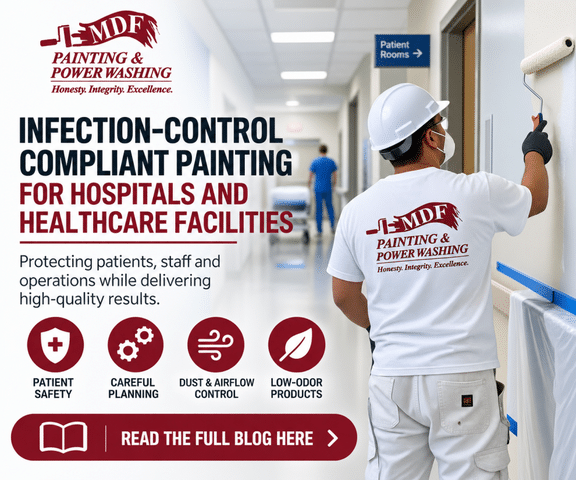
Infection-Control-Compliant Painting for Hospitals and Healthcare Facilities
Hospital Painting Requires More Than a Clean Finish
Painting inside a hospital is nothing like painting an ordinary office building. A hospital runs around the clock and serves patients who can be especially vulnerable to dust, mold spores, odors, and any disruption to critical services. Even a relatively small painting project can reach into patient rooms, clinical departments, isolation areas, labs, pharmacies, operating spaces, air-handling systems, public corridors, staff work areas, and emergency access routes without anyone intending it to.
That's exactly why painting inside an occupied healthcare facility has to be planned as an infection-control project, not simply a decorating one. The contractor needs to coordinate closely with the hospital's facilities, infection-prevention, environmental-services, engineering, safety, and clinical teams before a single drop cloth goes down. The goal isn't just applying paint correctly — it's completing the project without letting dust, debris, odors, equipment, workers, or altered airflow create any unnecessary risk for the people in that building.
What Does "Infection-Control Compliant" Actually Mean?
There's no single universal certificate or one-size-fits-all procedure that covers every hospital. In practice, it means the painting contractor follows that specific facility's approved infection-prevention requirements for the work being done — the activity itself, the location, the patient population nearby, the department, how the air handling is set up, the condition of the surfaces, how much dust the work generates, how long it'll take, and which products are being used.
Healthcare facilities typically work through an Infection Control Risk Assessment, usually called an ICRA, to evaluate renovation and maintenance activity like this. The CDC strongly supports performing that kind of risk assessment before any construction, renovation, repair, or activity likely to kick up dust or water aerosols. The resulting plan can call for barriers, negative air pressure, HEPA filtration, sealed ventilation openings, controlled worker access, specific debris removal procedures, particular products, defined work hours, patient relocation, and a final inspection before anyone reopens the space. A contractor taking on this kind of work has to be ready to follow that plan exactly as written.
Why Painting Creates a Real Infection-Control Concern
Painting itself seems harmless enough, but the preparation that comes before it can disturb contaminants that had been sitting settled or hidden for years. Sanding, scraping, cutting into drywall, removing old wall coverings, repairing plaster, opening up walls, drilling, caulking, stripping deteriorated coatings, and cleaning stained or damaged surfaces can all release dust, mold spores, fungal particles, drywall debris, paint chips, fibers, odors, and chemical emissions into the surrounding air.
CDC materials are direct about this — dust, mold, and germs disturbed during healthcare construction, renovation, and maintenance can genuinely endanger both workers and patients. That risk climbs considerably near immunocompromised patients, oncology and transplant units, neonatal care, intensive care, surgical departments, respiratory care, and clinical labs. A project that would need almost no special controls in an administrative office might demand much stricter containment just a few doors down in a patient-care area.
Start With an Approved Infection Control Risk Assessment
A contractor shouldn't be the one deciding, on their own, what level of containment is appropriate. Before work begins, the hospital needs to determine the type of work involved, how much dust or disruption to expect, the patient-risk category for that area, which class of precautions applies, whether the space needs to be vacated, whether temporary barriers or negative pressure are required, how ventilation will be handled, which travel routes workers can use, how waste will leave the building, and what cleaning and clearance procedures apply before reopening. The painting contractor should be at the preconstruction meetings and make sure the whole crew actually understands what's been agreed to — and all of that should be documented in writing, not just discussed verbally.
Keep the Work Area Truly Separate From Patient Care
Containment is probably the single most important piece of healthcare painting. Depending on the ICRA and the scope of the project, that might mean sealed plastic barriers, rigid temporary walls, zippered access doors, anterooms, floor-to-ceiling partitions, sealed penetrations, covered ceilings, controlled entry points, warning signage, and restricted access. CDC guidance calls for barriers that keep dust from construction areas away from patient-care spaces entirely, and specifies that those barriers should be impermeable to fungal spores and meet applicable fire codes.
That barrier has to stay intact for the entire project. A containment system that gets opened repeatedly, left unsecured, or punctured by cords and hoses that were never properly sealed isn't really protecting anything.
Get Airflow and Ventilation Right
Dust and odors don't stay put — they can travel well beyond the immediate work area through a building's HVAC system. Before starting, the facility and contractor need to figure out which supply vents serve that area, where the return-air vents sit, whether they need to be sealed, whether the system needs to keep running, whether air should be exhausted outside, whether negative pressure is required, whether portable HEPA-filtered equipment is needed, and how pressure relationships will be monitored throughout the job.
CDC guidance recommends blocking and sealing return-air vents when rigid containment barriers are in use, and negative pressure is often needed to keep dust and airborne contaminants from escaping the work zone. None of this should be improvised — it has to be designed and approved alongside the hospital's engineering and infection-prevention teams. A painter should never alter a healthcare ventilation system without that authorization.
Use HEPA-Filtered Dust Control, Not Household Equipment
Standard shop vacs and open sanding methods just aren't appropriate for most occupied healthcare projects. Where required, that means HEPA-filtered vacuums, vacuum-attached sanders, HEPA air-scrubbing equipment, controlled scraping methods, wet-cleaning techniques, and dust-capturing tools — all aimed at catching contaminants right at the source instead of letting them spread through the room and out into the rest of the facility. That equipment needs to be properly maintained, correctly sized for the job, inspected before use, run continuously when the plan calls for it, and positioned exactly according to the containment plan. Filters and collected debris also need to be handled carefully so dust doesn't get released right back into the building during cleanup.
Choose Low-Odor, Low-Emission Products Carefully
Product selection matters a lot more in an occupied hospital than it does anywhere else. Strong odors and chemical emissions can genuinely affect patients, visitors, and staff — especially anyone with respiratory conditions, chemical sensitivities, asthma, or already-compromised health. Low-VOC and zero-VOC coatings can help reduce that indoor pollution load, though VOC content is just one factor alongside durability, chemical resistance, cleaning requirements, and the overall makeup of the product. The EPA also recommends proper ventilation and following product-label precautions whenever materials that emit volatile organic compounds are being used.
The hospital should sign off on the primer, the finish coating, patch compounds, caulk, adhesives, cleaners, solvents, and even the floor-protection materials being brought in. And it's worth remembering that the lowest-VOC coating isn't automatically the right coating — whatever gets chosen still has to hold up against the hospital's cleaning products, disinfectants, abrasion, moisture, and everyday traffic in that particular area.
Work Around Patient Care, Not the Other Way Around
Healthcare painting often has to happen at night, on weekends, between patient appointments, during temporary room closures, in carefully phased sections, or during quieter occupancy periods. Scheduling should be worked out with whichever department actually uses that space, factoring in medication rounds, patient sleeping hours, surgical schedules, emergency access, shift changes, meal service, visiting hours, cleaning schedules, diagnostic procedures, and quiet-hour requirements. The contractor needs to understand, going in, that the hospital's operational needs come first, full stop — and that the crew may need to stop work immediately if a clinical emergency comes up.
Set Controlled Routes for Workers and Materials
The crew shouldn't be wandering freely through the building. The project plan should spell out approved routes for worker arrival, equipment delivery, moving paint and ladders around, waste removal, breaks, restroom access, and emergency evacuation. Wherever possible, that project traffic should stay separate from patient transport, sterile supply routes, food-service routes, public entrances, emergency departments, and high-risk clinical areas. CDC recommendations even include actively diverting pedestrian traffic away from active work zones as part of overall dust-control planning. Workers should stay within their approved areas and steer clear of unrelated departments entirely.
Protect More Than Just Floors and Furniture
Healthcare painting means protecting a lot more than the usual furniture and flooring — think medical equipment, nurse-call systems, gas outlets, electrical devices, fire-alarm components, sprinklers, wall-mounted monitors, hand-sanitizer dispensers, door hardware, infection-control dispensers, signage, security devices, and clinical casework. Nothing in that list should be covered, disconnected, relocated, or blocked without explicit permission, and fire protection, emergency systems, medical-gas equipment, and life-safety devices need to stay accessible and fully functional unless the facility has formally approved a shutdown.
Keep Tools and Workers From Spreading Contamination
Tools and equipment used inside the containment zone shouldn't just walk out into clean hospital spaces without being cleaned first. That might mean dedicated tools, sticky mats, shoe covers, protective clothing, tool wipe-downs, equipment decontamination, HEPA vacuuming, and controlled removal procedures. Workers shouldn't be setting dirty equipment on clean floors or rolling dusty ladders through patient areas, and the crew needs to follow the hospital's own rules on hand hygiene, PPE, respiratory protection, isolation areas, vaccination or health screening, exposure reporting, and food and beverage restrictions — all of which will vary somewhat from one facility to the next.
Keep the Jobsite Clean the Entire Time, Not Just at the End
Cleaning has to happen continuously throughout the project, not just once it wraps up. Daily routines might include HEPA vacuuming, damp wiping, removing waste, cleaning tools, inspecting the barriers, replacing sticky mats, checking pressure readings, sealing paint containers, removing contaminated protective materials, and documenting which controls were actually followed that day. Dust and debris should never be allowed to pile up. Waste often needs to be bagged inside containment, sealed before it's removed, covered during transport, taken out through a designated route, and removed only during approved hours — all according to the facility's environmental-services and disposal requirements.
Bring In Trained, Identifiable Workers
Hospital painting shouldn't be handed off casually to an unfamiliar crew. Workers need real training on that facility's ICRA requirements, containment procedures, dust control, PPE, emergency response, approved travel routes, patient privacy, professional conduct, and infection-prevention expectations. Every single worker should know where they can and can't go, who's supervising the project, what to do if containment fails, what to do if a patient wanders into the work zone, how to report a spill or exposure, and when to stop work entirely. Crew members should wear clear company identification and answer to an onsite supervisor at all times.
Respect Patient Privacy and Professional Conduct
Painting crews often end up working close to patient rooms, nursing stations, registration desks, and confidential records. Workers shouldn't be photographing patients, discussing patient information, entering unauthorized rooms, reading charts or computer screens, blocking patient access, using inappropriate language, playing loud music, smoking or vaping on the property, or interacting unnecessarily with patients. This isn't just a professionalism issue — unnecessary movement and interaction can genuinely disrupt care and introduce avoidable traffic into areas that are supposed to be controlled.
Keep Monitoring Containment the Whole Time
Setting up containment on day one isn't enough — it has to be checked regularly for the duration of the project. That means routinely inspecting barrier integrity, door closures, vent seals, pressure relationships, HEPA equipment, dust buildup, worker compliance, waste routes, signage, floor protection, and the adjacent areas nearby. Any breach needs to be reported right away, and depending on the facility's protocol, work may need to stop entirely until the barrier is repaired, the surrounding area is cleaned, airflow is restored, and infection prevention signs off on restarting. A contractor should never try to hide or downplay a containment failure — that's exactly the kind of thing that needs to come to light immediately.
Coordinate Final Cleaning and Reopening Carefully
The contractor shouldn't be the one deciding to remove containment or reopen the space — that requires facility approval. Wrapping up the project properly usually means removing all debris, HEPA vacuuming, damp cleaning, disinfecting surfaces, inspecting above the ceilings, cleaning inside the containment area itself, verifying airflow and pressure, checking for lingering odors, removing protective materials, having environmental services do their own cleaning pass, and getting a final infection-prevention inspection and facilities sign-off. It's the hospital, not the painting contractor alone, that ultimately determines when the space is ready to go back into service.
Paint Durability and Infection Control Are Not the Same Thing
A coating marketed as antimicrobial is not a substitute for proper cleaning, disinfection, containment, hand hygiene, or established infection-prevention practices. Healthcare coatings can genuinely offer washability, scrub resistance, stain resistance, moisture resistance, chemical resistance, and smooth, easy-to-clean surfaces — all of which support ongoing facility maintenance. But no coating should ever be marketed or treated as a replacement for the infection-control procedures already in place. The right product still has to be chosen based on the facility's actual performance needs and its approved cleaning products.
Questions Healthcare Facilities Should Ask Before Hiring
Before awarding a hospital painting project, I'd ask whether the contractor has actually completed work in occupied healthcare facilities before, whether their supervisors understand ICRA requirements, and how they train workers on infection-control procedures. Ask whether they can follow a facility-specific containment plan, whether they own or have access to HEPA-filtered equipment, and how they'll control dust from sanding and scraping. Ask how they'll maintain negative pressure when it's required, how workers and materials will enter and exit the project area, how debris will actually leave the building, and how they'll protect ventilation openings and prevent cross-contamination. Ask which low-odor or low-emission products they'd recommend, and whether those coatings can hold up against the hospital's own disinfectants. Ask whether the same trained crew will stay on the project start to finish, who supervises each shift, whether they can work nights or weekends, and how they'll document daily compliance. And ask what happens if containment gets breached, how final cleaning will be coordinated, and whether they'll wait for the facility's approval before reopening the space. A contractor's answers here should be specific to healthcare work — not generic reassurances about keeping a clean job site.
Red Flags to Watch For
I'd be cautious of any contractor who has never worked in an occupied healthcare environment, doesn't understand what an ICRA even is, or treats painting as a low-risk activity without properly evaluating the prep work involved. Same goes for anyone planning to sand without containment, showing up with no HEPA-filtered equipment, unable to explain their containment plan clearly, or intending to seal ventilation without engineering sign-off. Watch out for contractors choosing products based only on price, with no real plan for odor control, who can't work around a clinical schedule, who bring in unfamiliar or untrained labor, or who have no onsite supervisor and no daily documentation. And be especially wary of anyone planning to pull down barriers or reopen a space without facility approval, or treating final cleanup like an ordinary construction job. A beautifully painted wall isn't worth much if it came at the cost of patient safety.
Mark's Pro Tip
Before the project starts, I'd walk the actual space with representatives from facilities, infection prevention, environmental services, engineering, safety, the affected clinical department, and the painting contractor — all together, in person. During that walkthrough, identify exactly where the containment boundaries will sit, where the ventilation openings are, which door the workers will use to enter, the waste route, the emergency exits, where equipment will be staged, the approved work hours, and who's responsible for what cleaning. Don't rely entirely on drawings or emails for this. Walking the real route in person almost always surfaces risks that never showed up during the estimating process.
Common Mistakes I See in Healthcare Painting Projects
The biggest one is starting work before the ICRA is actually approved. Right behind that is assuming painting won't generate meaningful dust, using barriers that don't fully seal the space, failing to control return-air vents, or letting doors stay open when they shouldn't. I'd also flag moving dusty tools through clean corridors, using products the facility never approved, ignoring odor migration, leaving waste uncovered, letting unfamiliar workers onsite, failing to actively monitor containment, reopening an area without approval, assuming an antimicrobial coating replaces real cleaning, and scheduling the work around the contractor's convenience instead of patient care.
Bottom Line
Painting inside a hospital or healthcare facility has to be treated as a controlled operational and infection-prevention project, not just a cosmetic one. The contractor needs to manage dust, airflow, containment, odors, product selection, worker movement, debris, patient privacy, clinical scheduling, cleaning, documentation, and final clearance — and the correct approach to all of it depends on the location, the specific work, the patient population nearby, and the facility's approved Infection Control Risk Assessment.
At MDF Painting & Power Washing, we understand that healthcare painting is about a lot more than how the walls look afterward. A successful project protects vulnerable patients, supports clinical operations, respects hospital staff, keeps the environment controlled, and still delivers a durable finish — all without creating unnecessary disruption along the way. The best healthcare painting project is the one patients barely notice happened, staff can confidently work around, and facility managers know was carried out exactly according to the approved plan.
Frequently Asked Questions
What is an Infection Control Risk Assessment?
An ICRA is a process used to identify infection risks tied to construction, renovation, repair, or maintenance work, and to establish the precautions needed before that work begins. The CDC supports using this kind of assessment for any activity likely to generate dust or water aerosols.
Is painting considered construction activity in a hospital?
It can be, particularly when the project involves sanding, scraping, wall repair, demolition, ceiling access, or other dust-producing work. The specific controls required depend on the facility's risk assessment.
Does every hospital painting project require full containment?
No. The level of containment depends on the type of work, the location, the patient population nearby, how much dust is generated, the airflow situation, and the facility's approved ICRA.
Why are HEPA vacuums so important?
HEPA-filtered equipment helps capture fine particles at the source instead of letting them spread through occupied healthcare areas, and its use should follow the facility's infection-control plan.
Should HVAC vents always be sealed during a project like this?
Not automatically — ventilation decisions need to be coordinated with the hospital's engineering and infection-prevention teams. CDC guidance recommends sealing return-air vents when rigid barriers are used, but the exact plan still needs facility approval.
Are zero-VOC paints always required?
Not necessarily. Facilities often prefer low- or zero-VOC products to cut down on emissions and odor, but product choice also has to account for durability, chemical resistance, washability, surface compatibility, and operational needs.
Can antimicrobial paint actually prevent hospital infections?
No — antimicrobial or specialty coatings shouldn't be treated as a replacement for cleaning, disinfection, containment, hand hygiene, or established infection-prevention procedures.
Can hospital painting happen while the building stays occupied?
Yes, in many cases. But the work needs to be carefully phased and controlled according to the hospital's infection-prevention, engineering, safety, and operational requirements.
Who decides when a painted area can reopen?
The healthcare facility itself, after all required cleaning, inspections, ventilation checks, and infection-prevention clearance have been completed.