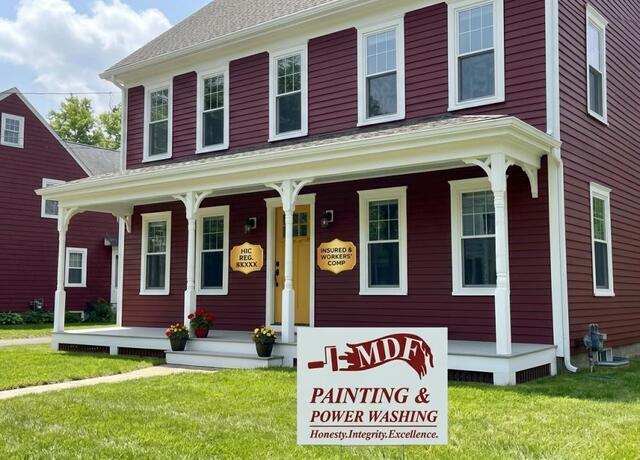
Registered and Insured vs. Unregistered or Uninsured Painters: What Connecticut Homeowners Should Know
Is Your Painter Properly Registered and Insured?
When homeowners compare painting estimates, they usually zero in on price, prep work, products, and reviews. All of that matters, but before you let anyone work in or around your home, there's something else worth checking: whether the business is properly registered and adequately insured.
Here in Connecticut, people often use the phrase "licensed painter," but that's not quite the right term. Painting contractors doing qualifying residential home-improvement work are generally required to hold an active Home Improvement Contractor registration through the Connecticut Department of Consumer Protection. It's a small distinction, but it matters. A registration doesn't automatically prove someone is a skilled painter or that their workmanship will be excellent — what it does show is that they've taken the steps required to legally operate in this state. Insurance is a different kind of protection altogether, one that addresses the financial risk if something goes wrong — property damage, an accident, an injury on the job. Ideally, you want a contractor who checks both boxes: properly registered and adequately insured. Here's what I think every Connecticut homeowner should understand before signing anything.
Registration and Insurance Aren't the Same Thing
These two things serve completely different purposes, and it's worth keeping them separate in your head. A Connecticut Home Improvement Contractor registration is what legally allows someone to perform qualifying home-improvement work in this state, and you can actually look up whether a contractor's registration is active through Connecticut's public eLicense system. Insurance, on the other hand, protects against financial losses tied to the project itself — mainly general liability insurance and workers' compensation insurance. Here's the catch: a contractor can be registered but carry very limited insurance, or claim to be insured while their registration has actually lapsed. You really do need to verify both, independently of each other.
What Exactly Is a Connecticut HIC Registration?
Connecticut requires home-improvement contractors to register with the Department of Consumer Protection, and the state is pretty direct about this — they advise homeowners to confirm a contractor's registration is active before hiring them, and they've explicitly warned that doing home-improvement work with an inactive or missing registration is illegal. A registration gives you a state credential number, a public record you can actually verify, a business identity tied to that registration, and a way to check whether it's currently active. That said, registration alone doesn't guarantee good workmanship — it's still on you to look into reviews, experience, project scope, communication, and references. Think of an active registration as a basic starting requirement, not the finish line.
How to Actually Verify a Registration
Don't take a registration number at face value just because it's printed on a truck, a business card, an ad, or a proposal — that number could be expired, inactive, tied to a completely different company, or just presented incorrectly. Connecticut's Department of Consumer Protection runs a public eLicense portal where you can search by a contractor's name or business name and see whether the registration is actually active. While you're in there, check that the business name matches the company you're actually hiring, that the registration shows as active, that the address and identifying details line up, and that whoever's named in your contract matches what's on file. It takes a few minutes, and it's worth doing before you sign anything or hand over a deposit.
What General Liability Insurance Actually Covers
General liability insurance is meant to cover certain claims involving property damage or bodily injury connected to the contractor's work. Depending on the policy and circumstances, that could mean coverage if a crew damages your hardwood floors, breaks a window, causes overspray on a car or a neighbor's fence, damages your landscaping, spills paint somewhere it shouldn't be, or accidentally damages part of your home. Connecticut requires HIC registration applicants to carry at least $20,000 in general liability coverage — but I'd point out that the state minimum can be a lot less than the actual value of your home or the cost of a serious claim. Don't just ask whether a policy exists. Ask what the actual coverage limits are.
What Workers' Compensation Insurance Actually Covers
Workers' compensation is there to provide benefits to employees who get hurt or become ill because of their work, and with few exceptions, Connecticut employers are required to carry it for their employees. Painting isn't a low-risk trade — it involves extension ladders, scaffolding, sometimes roof access, heavy equipment, sanding tools, chemical products, slippery surfaces, stairwells, and high ceilings, all of which create real injury risk. If a painting company has employees, ask for proof of workers' comp rather than just assuming they're covered. It's a reasonable question, and a legitimate business shouldn't hesitate to answer it.
Why "We're Fully Insured" Doesn't Tell You Enough
I hear this phrase a lot, and honestly, it can mean a lot of different things. A company might carry general liability insurance but skip workers' compensation entirely. Or the people actually working on your property might be subcontractors whose coverage was never verified in the first place. It's worth asking these as separate questions: Do you carry general liability insurance? Do you carry workers' comp? Does that coverage extend to everyone who'll actually be working at my home? Will you be using subcontractors, and if so, how do you verify their insurance? Don't let one blanket statement stand in for all of these answers.
Ask for a Current Certificate — Not a Website Claim
A logo that says "fully insured," a statement on someone's website, an old insurance certificate, a verbal promise, or a photo of a policy page — none of that is really proof. Ask for a current Certificate of Insurance, and when you get it, check the business name on it, the policy dates, what's covered, the coverage limits, who the carrier is, and whether workers' comp is listed at all. The business name on that certificate should match the business named in your contract. If you want extra peace of mind, you can ask the insurance agent or carrier to send a certificate directly to you.
Make Sure the Policy Is Actually Still Active
Here's something people miss: a certificate only reflects coverage as of the date it was issued. Policies can be canceled, allowed to lapse, changed, replaced, or limited by exclusions after that. For a bigger project, it's not unreasonable to ask to be listed as a certificate holder so you get documentation directly from the contractor's insurance provider. A certificate holder isn't quite the same thing as being named an additional insured, so if you have real questions about your own protection, it's worth a quick conversation with your own insurance agent or attorney.
Find Out Who's Actually Going to Be Working on Your Home
Some painting businesses use their own employees, some rely on subcontractors, and plenty use a mix of both. None of those arrangements is automatically a red flag — what matters is knowing who's responsible for hiring, training, supervising, and insuring the people on your property, and who's on the hook if there's a mistake, an injury, or a warranty claim down the line. Ask directly whether everyone working at your home is covered under the contractor's insurance, or carries their own valid coverage.
Don't Just Take Someone's Word That a Subcontractor Is Covered
I've heard contractors say things like, "They're subcontractors, so I don't need workers' comp for them." The truth is, how a worker gets classified isn't just up to what a company decides to call them — it can depend on a number of legal and factual details that go beyond a label. As the homeowner, you don't need to become an employment law expert here. What you should do is ask the contractor to actually demonstrate that everyone on your property is properly covered, and that they have a real process for verifying subcontractor insurance rather than just assuming it. Vague reassurances aren't good enough.
Why an Uninsured Painter Might Quote You Less
Insurance is a real, ongoing cost for a legitimate contractor. A company carrying general liability, workers' comp, commercial auto insurance, proper payroll, safety equipment, and employee training simply has more overhead than someone skipping all of that — and that difference shows up in the estimate. An uninsured painter isn't necessarily quoting less because they're more efficient. More often, they're just shifting the risk somewhere else — onto you, onto their own workers, onto your property, or onto other contractors who are actually doing things the right way. A lower number on the page shouldn't automatically be read as a better deal.
The Real Risk of Hiring Someone Uninsured
Bringing in an uninsured or under-insured contractor can leave you exposed in ways that aren't obvious until something actually goes wrong — property damage with no reliable way to get reimbursed, an injured worker with no coverage, disputes over who's responsible for what, damage claims involving a neighbor's property, work that gets abandoned halfway through, or real difficulty holding anyone accountable if the "company" barely has a real business structure behind it. And I'll say this plainly: your own homeowner's insurance is not a substitute for the contractor's business insurance. If you have questions about how your policy would respond to a contractor-related accident, that's a conversation worth having with your own agent.
An Active Registration Doesn't Equal Skill
I want to be clear about this — registration matters, but it's not proof of craftsmanship. It doesn't tell you whether a contractor has real painting experience, uses good materials, preps surfaces properly, trains their employees, supervises well, communicates clearly, offers a real warranty, or consistently produces great results. Think of it as a minimum business requirement, not a full evaluation of quality. You still need to look at references, online reviews, photos of past work, how long they've been in business, the written scope of work, their preparation process, crew structure, warranty, and how they communicate.
Insurance Doesn't Guarantee Quality Either
An insured contractor can still turn out mediocre work — insurance addresses specific financial risks, not workmanship. The contractor you actually want combines an active registration, appropriate insurance, real painting experience, thorough preparation, trained painters, professional supervision, a detailed contract, strong customer service, and a written warranty. No single credential tells the whole story, so it's worth evaluating the whole company rather than checking one box and calling it done.
Read the Written Contract Closely
Connecticut residential home-improvement contracts are required to include specific details — the contractor's name and address, their Connecticut registration number, signatures, the date of the agreement, and the date by which you're allowed to cancel. That cancellation period generally runs three business days after signing, and Saturday counts as a business day in that calculation. Beyond what the state requires, your agreement should also spell out the surfaces included, the preparation involved, the paint products, the number of coats, any repairs, protection procedures, when work is expected to start, the payment schedule, how change orders get handled, the warranty, and any exclusions. Don't rely on a verbal promise for anything that isn't actually written into the contract.
Be Cautious With Cash-Only Deals
Paying cash isn't automatically a problem. But I'd slow down if a contractor refuses to provide a written agreement or a receipt, asks you to write a check to someone unrelated to the business, offers a big discount in exchange for an undocumented payment, avoids clearly identifying their legal business, or won't share their registration or insurance information. Every payment should be documented and tied to the business actually named in your contract.
Red Flags Worth Taking Seriously
Slow down, or consider another contractor entirely, if someone has no active Connecticut registration, won't provide proof of insurance, tells you insurance isn't necessary, can't clearly explain who actually employs the workers on-site, hands you a certificate under a different business name, pressures you to sign on the spot, asks for most or all of the money upfront, only offers a verbal agreement, describes the work vaguely, refuses to put a warranty in writing, or can't explain what happens if there's an injury or property damage. One red flag might have a reasonable explanation behind it. Several together are worth taking seriously.
Questions Worth Asking Every Painter
Before you hire anyone, I'd ask for their Connecticut Home Improvement Contractor registration number and confirm it's currently active. Ask for a current general liability insurance certificate and their actual coverage limits. Ask whether they carry workers' compensation, and whether that coverage applies to everyone working at your home — including any subcontractors, and how those subcontractors' insurance gets verified. Ask who's supervising the project, whether the business named in your contract matches the registered and insured company, what happens if something gets damaged or someone gets hurt, whether the insurance certificate can be sent directly to you, and whether the warranty terms are actually in writing. A contractor worth hiring should answer all of this without hesitation.
Mark's Pro Tip
Before you sign anything, I'd do three quick things: look up the contractor's business name in Connecticut's eLicense system, ask for current certificates for both general liability and workers' comp insurance, and confirm that the same legal business name shows up consistently across the registration, the insurance documents, the proposal, the contract, and the payment instructions. If those names don't match up, stop and ask for an explanation before you hand over a deposit.
Mistakes I See Homeowners Make
The biggest one is treating "licensed," "registered," and "insured" as if they're interchangeable terms — they're not. Right behind that is checking a registration number without confirming it's actually active, accepting an expired insurance certificate, checking on general liability while forgetting to ask about workers' comp, assuming subcontractors are automatically covered, not comparing the business name across every document, treating the lowest price as the lowest risk, trusting verbal promises, and assuming that either registration or insurance alone guarantees good workmanship. I'd also add paying an individual when the contract is actually with a company, and signing something without reading the cancellation and payment terms first.
The Bottom Line
Hiring a painting contractor should involve more than just comparing colors and price tags. As a Connecticut homeowner, it's worth confirming that whoever you're hiring has an active Home Improvement Contractor registration and carries appropriate insurance for both the business and the people doing the work.
Registration doesn't guarantee great craftsmanship, and insurance doesn't guarantee a flawless paint job — but both are genuinely important parts of figuring out whether a contractor operates professionally and responsibly. The strongest contractors can offer all of it together: an active registration, current insurance documentation, a consistent legal business identity, a detailed written contract, a clear crew and supervision structure, a real preparation plan, a written warranty, and a track record of finished projects you can actually verify.
At MDF Painting & Power Washing, we believe homeowners should never feel awkward asking for registration, insurance, or contract details. These aren't intrusive questions — they're just part of hiring a professional and protecting everyone involved in the project.
Frequently Asked Questions
Do painters need a license in Connecticut?
Connecticut generally requires qualifying residential painting contractors to hold a Home Improvement Contractor registration rather than a painting-specific occupational license. Certain specialized trades — electrical, plumbing, HVAC, and similar work — do require separate professional licenses.
How can I check whether a painter is registered?
Search the contractor's individual or business name through Connecticut's public eLicense portal, confirm the registration is active, and make sure the business information matches what's in your contract.
Does contractor registration mean the painter is insured?
Registration applicants have to provide general liability insurance information and meet Connecticut's minimum coverage requirement, but you should still ask for a current certificate and check the actual coverage limits and policy dates yourself.
Does general liability insurance cover injured workers?
No — general liability and workers' comp are different types of coverage entirely. Workers' comp is what addresses qualifying work-related employee injuries or illness.
Does every contractor need workers' compensation insurance?
With limited exceptions, Connecticut employers are required to maintain workers' comp for their employees. Coverage questions involving owners, sole proprietors, LLC members, or subcontractors can get more complicated, so it's better to ask for documentation than to assume.
Should I hire a contractor whose registration has expired?
No. Ask them to renew it and confirm it's active before signing anything or letting work begin — Connecticut has said outright that doing home-improvement work with an inactive or missing HIC registration is illegal.
Is the cheapest uninsured painter worth the risk?
That's ultimately your call, but an uninsured contractor can expose you to real uncertainty around injuries, property damage, incomplete work, and financial responsibility. It's worth comparing total protection and value, not just the number on the estimate.
Can I ask the insurance company to verify coverage directly?
Yes. Ask the contractor to have their insurance agent send a current certificate straight to you. The agent can confirm the policy's current status, though they generally can't give you legal advice about how coverage would apply to a specific claim.