How to Compare Painting Estimates: A Connecticut Homeowner's Guide
Why the Lowest Estimate Isn't Always the Best Deal
You've met with a few painting contractors, gotten their proposals back, and now it's decision time. One estimate is noticeably lower than the others. Another runs several pages long. One contractor promises two coats without much explanation, while another spends most of the conversation talking about preparation instead of paint. So how do you actually figure out which one is the better deal?
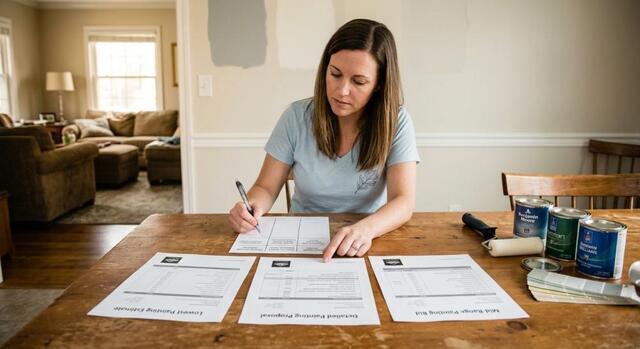
The first thing to understand is that painting estimates aren't automatically built on the same scope of work. Two contractors can walk through the exact same house and come back with completely different levels of preparation, protection, materials, supervision, service, and warranty coverage. That means comparing only the bottom-line price can be genuinely misleading. A much better approach is to go through each proposal line by line and figure out exactly what you'd actually be getting for your money.
Start by Confirming Everyone's Quoting the Same Areas
Before you compare a single dollar figure, make sure each proposal covers the same surfaces. For an interior project, that means checking whether walls, ceilings, baseboards, crown molding, window trim, door frames, doors, closets, built-ins, stair railings, and cabinets are all included — or whether some of those got left out. Oftentimes actual window sashes are never discussed because less experienced contractors may assume they are replacement windows. Whether or not the actual window mullions or casements are painted can add or subtract a significant amount of time to your project. For an exterior project, you'll want to know if siding, trim, fascia boards, soffits, doors, the garage door, shutters, porch ceilings, railings, the foundation, decks, and any detached structures like a shed are all part of the deal. A lower price sometimes just means fewer surfaces are included. Don't assume "painting the house" means the exact same thing to every contractor who walks through your door.
Compare How Each Contractor Approaches Preparation
Preparation is usually where the real difference between two estimates can be found. Interior prep might involve filling nail holes, repairing drywall cracks, sanding rough areas, caulking gaps, treating stains, priming repairs, cleaning grease or residue, and protecting your floors and furniture along the way. Exterior prep tends to be more involved — washing, scraping loose paint, sanding rough edges, replacing failed caulk, priming bare wood, treating mildew, repairing damaged surfaces, and protecting the roof and landscaping while the crew works. One proposal might build in several days of real preparation, while another amounts to little more than light cleaning before the paint goes on. That gap affects both the price today and how long the paint job lasts down the road. Tip: ask potential painting contractors how many man hours of electric sanding they plan to perform on your home–you will be amazed by the vast differences in their opinions on prep.
Ask What "Preparation" Actually Means in Practice
Words like "scrape," "sand," and "prepare as needed" sound reassuring, but they can mean very different things depending on who's writing the proposal. I'd ask each contractor directly whether all loose paint will actually be scraped, whether rough edges will be sanded, whether bare wood will be primed, and whether cracked caulk will be removed and replaced or simply painted over. Ask how many drywall or wood repairs are included, whether there's a cap on preparation hours, and what exactly would trigger an additional charge. A contractor who's confident in their process should be able to walk you through all of this without hesitation.
Look Closely at the Paint Products Themselves
A proposal should name the actual manufacturer and product line being used — "premium paint" or “Sherwin-Williams” or “Benjamin Moore” on their own doesn't tell you much. Ask about the specific product, the recommended sheen, the primer that goes with it, and how it performs in terms of durability, washability, moisture resistance, and color retention on your particular surface. Even within the same manufacturer's lineup, products can vary quite a bit in both price and performance, and wall paint, trim enamel, cabinet coatings, masonry products, and exterior siding paint are genuinely not interchangeable with one another.
Get Specific About What "Two Coats" Really Means
"Two coats" sounds like a clear, simple promise, but it's worth digging into what it actually includes. Does that mean one primer coat and one finish coat, or two full finish coats? Is it spot priming plus two coats, or a guarantee of complete coverage regardless of how many passes it takes? Some contractors price around a specific number of applications, while others promise full coverage no matter what that requires. It's worth asking directly what happens if the new color doesn't cover evenly within whatever number of coats was quoted.
Ask How the Rest of Your Home Will Be Protected
A professional paint job protects everything that isn't being painted, not just the surfaces that are. For interior work, ask how the crew plans to protect your hardwood floors, carpeting, furniture, cabinets, countertops, appliances, light fixtures, electronics, and personal belongings. For exterior work, ask about protection for the roofing, windows, landscaping, walkways, decks, patios, outdoor furniture, vehicles, and even your neighbor's property if the homes sit close together. Real protection takes materials, setup time, and careful workmanship, and it should be built into the scope of the job rather than treated as an afterthought once painting starts.
Find Out Exactly Who Will Be Doing the Work
Ask whether the crew on your property will be company employees, subcontractors, temporary labor, or some mix of the three. Beyond that, find out who's supervising the job, whether there's a dedicated crew leader, who's responsible for quality control, who you'll actually be talking to if you have a question, whether the same crew stays on your project start to finish, and who handles it if a concern comes up mid-project. A professional company should have a clear answer to all of this, not a vague one.
Confirm the Insurance Is Real, Not Just Claimed
Ask every contractor for current proof of both general liability insurance and workers' compensation insurance — not just a verbal assurance. General liability helps protect you if the contractor accidentally damages your property. Workers' compensation protects the crew if someone gets injured while working on your home. A contractor without proper coverage can sometimes offer a lower price simply because they're not carrying the same insurance costs a fully covered company does — but that lower price comes with real risk shifted back onto you.
Get a Realistic Sense of the Schedule
Each estimate should give you a reasonable sense of timing. Ask when the project can realistically begin, how long it should take, whether the crew will work consecutive days or come and go, how many painters will actually be assigned, what happens if weather delays an exterior job, and whether the contractor might pull the crew away to start another job before yours is finished. The fastest promised timeline isn't automatically the best one, but a good contractor should still have a clear, believable plan for getting the work done efficiently.
Don't Overlook Cleanup
A project isn't really finished the moment the last coat of paint goes on. Ask whether the contractor will remove all the masking materials, haul away job-related debris, vacuum or sweep the work areas, reinstall outlet covers, put furniture back where it belongs, label any leftover paint for you, and do a final walkthrough of the property before calling it done. The home should be left clean and ready to use, not just painted.
Read the Warranty Carefully, Not Just the Number of Years
Don't judge a warranty purely by its length. A ten-year warranty riddled with exclusions can actually offer less real protection than a shorter warranty with clear, dependable coverage. Ask whether it's actually in writing, what it covers, what's excluded, whether it covers both labor and materials, whether there's a service charge to use it, how claims get submitted, how quickly they're typically addressed, whether it transfers if you sell the home, and what maintenance you're expected to keep up with to stay covered. At the end of the day, a warranty is only as good as the company standing behind it.
Review the Payment Terms Line by Line
A solid proposal should spell out the deposit amount, any progress payments along the way, when the final payment is due, which payment methods are accepted, how change orders get priced and approved, what the cancellation terms look like, and whether financing is available if you need it. Be cautious of any contractor asking for the full project cost before work has even started — the payment schedule should feel fair to both sides.
Pay Attention to What's Excluded, Not Just What's Included
A good estimate will also tell you what's not covered — things like rotten wood replacement, extensive plaster repairs, lead or hazardous material remediation, wallpaper removal, moving unusually heavy furniture, removing window treatments, unforeseen water damage, specialty colors, extra coats caused by a major color change, or permit and lift costs. Clear exclusions aren't necessarily a red flag — honestly, they're often a sign the contractor is being upfront with you. The real concern is when important exclusions never get mentioned at all until they show up as a surprise charge.
Ask How Change Orders Actually Get Handled
Sometimes preparation uncovers things nobody expected — rotten wood, water damage, failed plaster, mold, hidden peeling, damaged siding, or layers of old failed paint. Ask whether any additional work discovered along the way will be explained to you before it begins, priced in writing, approved by you directly, and added through a formal change order. You should never be blindsided by a large add-on charge at the very end of a project.
Pay Attention to How Each Contractor Communicates
The estimating process itself tells you a lot about how a company operates. Did they show up on time? Did they actually listen to your concerns, or just push their own pitch? Did they inspect the surfaces carefully, explain their recommendations, and answer your questions directly? Was the proposal delivered when they said it would be? Is the scope written clearly enough that you actually understand it? In my experience, the way a contractor communicates during the estimate is a pretty reliable preview of what you'll get after you've signed the contract.
Weigh Reputation and Relevant Experience
Reviews are useful, but don't stop at the star rating. Read what people actually say about reliability, cleanliness, communication, preparation, crew professionalism, how problems got resolved, warranty service, and how the paint job has held up over time. It's also worth asking whether the contractor has specific experience with homes like yours — a historic shoreline property, a cedar-sided house, a contemporary interior, or a cabinet refinishing project can each call for a different kind of expertise.
Be Cautious With Estimates That Are Dramatically Low
If one proposal comes in noticeably lower than everything else, that's worth asking about directly. Sometimes that gap comes from limited preparation, lower-grade paint, fewer coats, uninsured labor, no workers' compensation coverage, use of subcontractors, minimal supervision, reduced protection, no written warranty, unclear change-order pricing, or limited cleanup. A low price isn't automatically dishonest or a sign of bad work — but you deserve to understand exactly why it's lower before you sign anything.
And Don't Assume the Highest Price Is Automatically the Best Either
A bigger number on the page doesn't guarantee better workmanship. The contractor charging the most should still be able to justify that investment with a detailed scope, thorough preparation, quality materials, strong communication, real protection for your property, an experienced crew, solid project management, and a warranty that actually means something. The goal isn't to chase the cheapest or the priciest option — it's to find the proposal that delivers the strongest overall value for your home.
A Simple Way to Keep It All Organized
Honestly, the easiest way to compare multiple proposals is to jot down each one's answers side by side — the areas included, the preparation process, any repairs built in, whether primer is included, the recommended finish coat system, the specific paint manufacturer and product, the surface protection plan, whether employees or subcontractors will be doing the work, proof of general liability and workers' comp, the estimated start date and duration, whether cleanup is included, whether there's a written warranty, the payment schedule, and the total investment. Once you lay all of that out together, the real differences between contractors become a lot easier to see.
If One Estimate Is Way Lower Than the Rest
I'd go back to that contractor and ask which preparation steps are actually included, whether all the same surfaces are covered, what specific paint product they're planning to use, how many coats are included, whether repairs are part of the price, whether they carry workers' compensation insurance, who's actually going to do the work, whether cleanup is included, whether there's a written warranty, and what could cause the final price to go up. A reputable contractor should have no trouble answering every one of these questions comfortably.
Mark's Pro Tip
Here's something I'd suggest to every homeowner comparing bids: ask each contractor to walk you through the estimate as if the project were starting tomorrow morning. Have them explain what the crew does first, how the surfaces get prepped, what gets protected, which products get applied, who's supervising, how the work gets inspected, and what happens after the final coat goes on. That conversation almost always reveals more about a contractor than the total price ever could.
Where I See Homeowners Get Tripped Up
The most common mistake is comparing only the final price without confirming that every proposal actually covers the same surfaces. Close behind that is not comparing the preparation process, accepting vague descriptions of the paint being used, not confirming the number of coats, overlooking insurance coverage, glossing over the exclusions, skipping the conversation about change orders, choosing a contractor based purely on warranty length, paying the full price upfront, ignoring poor communication during the estimating process itself, and trusting verbal promises that never made it into the written proposal.
Bottom Line
The best way to compare painting estimates is to compare the complete scope of work, not just the number at the bottom of the page. Look closely at the preparation, the repairs, the paint products, the number of coats, the surface protection, the insurance, the crew structure, the schedule, the cleanup, the warranty, the payment terms, and the exclusions.
When two estimates are far apart, there's almost always a reason behind it. Your job as a homeowner is to find that reason before you sign anything. The best estimate isn't necessarily the cheapest or the most expensive — it's the one that clearly explains exactly what will be done and delivers the strongest long-term value for your home.
At MDF Painting & Power Washing, we believe homeowners should understand exactly what they're paying for. Our proposals are built to clearly lay out the scope, the preparation process, the materials, the payment schedule, and the warranty, so you can compare your options with real confidence.
Frequently Asked Questions
How many painting estimates should I get?
Three is usually enough to compare scope, pricing, professionalism, and overall value — though the quality and detail of those estimates matters more than the sheer number you collect.
Why are painting estimates sometimes thousands of dollars apart?
The gap usually comes down to how much preparation and repair work is included, the products being used, the number of coats, insurance coverage, crew experience, protection provided, supervision, and warranty terms.
Should I tell contractors what other estimates cost?
You can, but it's often more useful to ask each contractor to explain and justify their own price and scope. That way you're evaluating each proposal on its own merits, rather than encouraging everyone to compete purely on price.
Should every painting estimate include two coats?
Not necessarily. The right coating system depends on the surface, the existing color, the new color, primer requirements, product specs, and expected coverage. Ask how the contractor plans to deliver a consistent, even final appearance. Keep in mind that older homes with multiple layers of paint may actually last longer with few additional coats added to the surface.
What should a professional painting estimate include?
It should clearly identify the surfaces being painted, the preparation process, any repairs, the materials being used, the number of coats, surface protection, cleanup, the schedule, payment terms, exclusions, and the warranty.
Is a verbal estimate acceptable?
A verbal conversation is fine for an initial discussion, but the final agreement should always be in writing. A written proposal cuts down on misunderstandings and gives you a clear record of exactly what was promised.
Should I just choose the painter with the longest warranty?
Not automatically. Look closely at what the warranty actually covers, what it excludes, and whether the company has the track record and stability to actually honor it years down the road. If you don’t love the company, you won’t love them coming back to do future work!
How much should I pay upfront?
Payment structures vary depending on the size and type of the project, but you should avoid paying the full amount before any work begins, and make sure the complete payment schedule is documented in writing. A company that does not require a signed contract or deposit to get your project in their schedule is more than likely not functioning professionally. Remember that estimating, scheduling, project management and future customer satisfaction and engagement are all part of a professional painting process.